Whether a shop sits behind Cloudflare or runs on Shopify barely separates the shops we rated Danger from those without a major warning. Both turn up about as often in either group. Other traces set the groups far apart, above all the imprint, the age of the domain and the payment methods on offer. We analysed 23,209 of our own checks, including 11,762 with the verdict Danger and 8,464 with the verdict No major warning (as of 16 Nov 2026). Neither group is a random sample. Most of the fake shops were already on warning lists, and most of the others were listed in merchant directories.
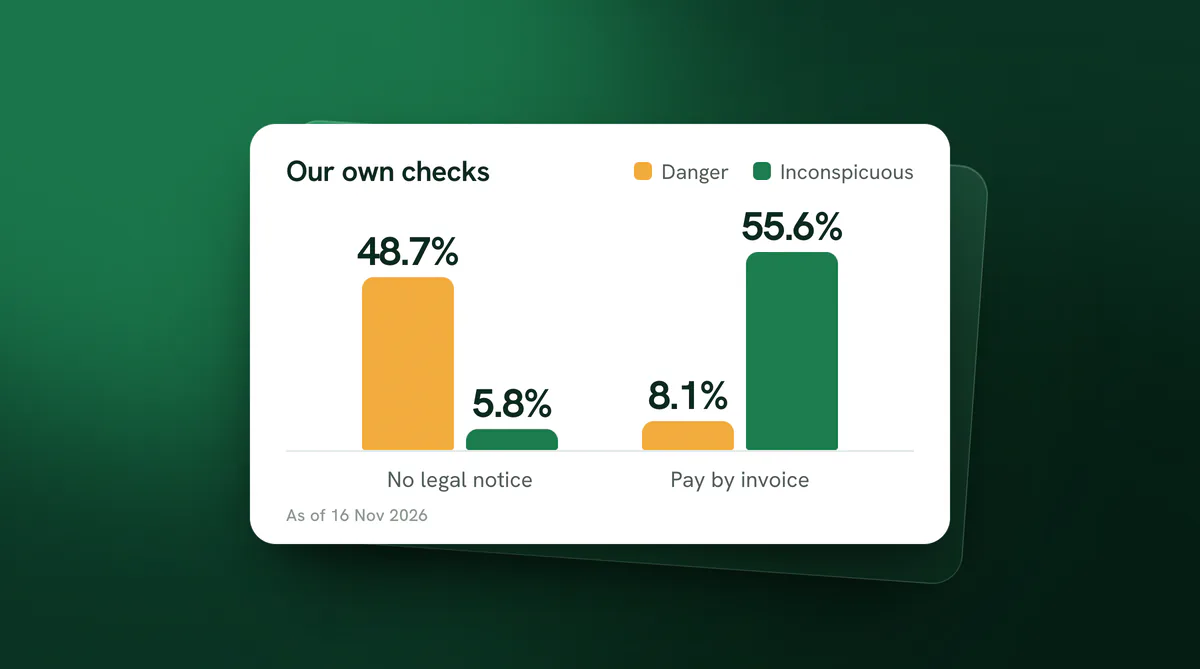
- 48.7%
- 353days
- 8.1%
What we counted
Our database holds 84,165 entries. 23,209 of them (27.6%) have a check result of our own with 27 to 40 check factors; the other 60,956 come from lists by other sources and are left out here. In this article, Danger means we checked the shop and gave it the verdict Danger (11,762). No major warning means our check raised no major warning (8,464). As a third group we use 1,078 shops without a major warning that appear in no merchant directory, and give their number wherever they come in. The queries ran read-only against our database on 16 Nov 2026. Because a feature only counts if the home page loaded and the check found something, every percentage has its own base.
Of 41,351 entries with the verdict Danger, 29,589 (71.6%) were unreachable at our last retrieval. They are list entries without a check of our own, and the data does not show whether these domains were ever online. So it cannot tell us how long a fake shop lasts on average. For 11,762 (28.4%) the shop delivered a page we could check. Every share in this article refers to these reachable shops.
Imprint and legal pages are missing most often at Danger shops
No other feature shows a wider gap. The figures cover shops whose home page loaded (Danger 7,626, no major warning 7,668, no major warning without list label 519). For 35% of the Danger checks the home page could not be loaded, and those shops are left out.
| Imprint | Dangern 7,626 | No major warningn 7,668 | No major warning, no list labeln 519 |
|---|---|---|---|
| No imprint found | 48.7% | 5.8% | 34.5% |
| Imprint without contact details | 28.8% | 4.3% | 22.0% |
| Imprint without a postal address that can be served | 3.8% | 0.6% | 3.7% |
| Imprint with contact details | 17.3% | 84.1% | 37.8% |
| All three legal pages linked (terms, withdrawal, privacy) | 10.7%n 7,627 | 76.6%n 7,662 | 30.0%n 513 |
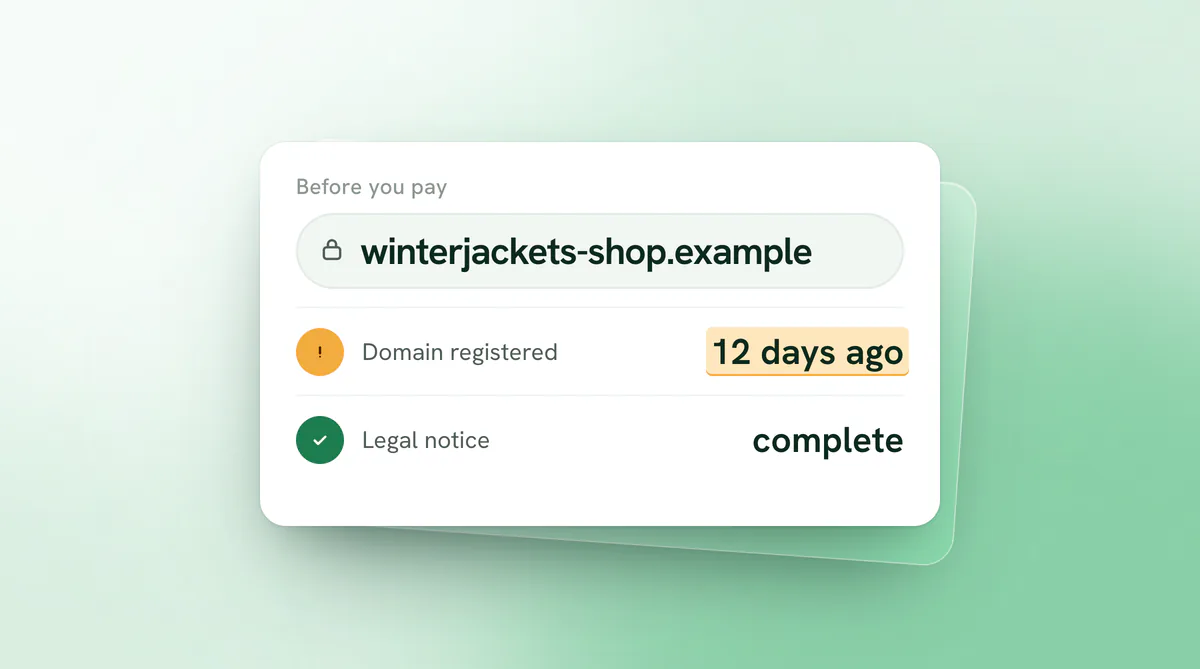
Put "no imprint", "no contact details", "no postal address that can be served" and "link leads nowhere" together and the Danger shops come to 82.7%, the shops without a major warning to 15.9% and those without a list label to 62.2%. The gap to the small group without a list label is therefore smaller than the gap to the large one. An imprint behind a script or under an unusual path counts as not found. Why shops must publish an imprint is explained in the glossary under imprint duty.
Domains of Danger shops are ten times younger at the median
Age here means the days between registration and our last check. When the shop landed on a list plays no part. We know the registration date for 7,209 Danger shops (about 61%) and 2,200 shops without a major warning (about 26%), since for many country endings the lookup returns nothing. If the missing cases are distributed differently, the share of young domains shifts.
| Domain age | Dangern 7,209 | No major warningn 2,200 | No major warning, no list labeln 570 |
|---|---|---|---|
| Median | 353 days | 3,579 days | 1,163 days |
| Younger than 30 days | 5.5% | – | – |
| Younger than 90 days | 20.4% | 0.8% | 1.6% |
| Younger than a year | 51.4% | 5.4% | 16.1% |
Against the large group the gap comes out too wide, because merchants from directories are over twelve years old at the median and drag the figure up. The fair comparison is with the third group, 353 against 1,163 days. On top of that, 49% of the Danger shops with a known date were older than a year. A young domain is a reason for suspicion, but on its own it proves nothing. More on this in the glossary under domain age.
Danger shops rarely name invoice or direct debit
We read the payment methods a shop names on its home page and one payment page. We did not read the checkout, and we did not measure whether the methods work there. Only pages where we found at least one payment method are counted: 4,235 Danger shops (36.1% of the Danger checks) and 6,509 without a major warning (76.9%).
| Payment method | Dangern 4,235 | No major warningn 6,509 |
|---|---|---|
| Invoice | 8.1% | 55.6% |
| Klarna | 10.2% | 46.9% |
| Direct debit | 1.3% | 22.8% |
Some Danger shops copy the complete payment lists of large retailers, so our count cannot show whether a method named on the page is offered at the checkout. Against the small group without a list label (n 271) the gap is smaller for Klarna (42.4%) and invoice (15.1%). We give no comparison for the word prepayment; it would set large retailers with a long payment page against pages that have none. How the methods differ when something goes wrong is covered in the article the prepayment trap, and there is an overview at payment methods.
Ending, shop software and host
For the ending we count the last label of the domain. Of 11,722 Danger shops with our own check, 52.7% end in .com, 16.8% in .shop and 15.7% in .de. Among 8,462 shops without a major warning the figures are 19.5% .com, 2.2% .shop and 59.9% .de. We do not compare the .de figure, since 87% of those shops come from German and Austrian directories. For .com the ratio is 2.7 to 1. The .shop ending turns up 7.6 times as often among Danger shops, and even against the small group without a list label (1,078 in total) it stays at about four times. Counted across all 41,349 Danger entries, including list entries without a check of our own, .com stands at 52.7%, .de at 18.9% and .shop at 11.1%.
Anyone can register a .shop address, and the shares only apply to the fake shops we have recorded. How operators set up hundreds of similar .shop addresses is described in the article clone fake shops under .shop domains.
For shop software our check recognises Shopify, WooCommerce and WordPress. Other systems such as Shopware or Magento are not stored and fall under "not detected or custom system". Among shops with a loaded home page (Danger 7,635, no major warning 7,662), 40.9% of the Danger shops ran on WooCommerce, against 14.3% of the shops without a major warning and 15.6% of those without a list label (n 513, rather small). Shopify does not separate the groups: 26.4% against 29.1% and 42.5%. Any merchant can install WooCommerce, and the software tells you nothing about the operator. It only counts alongside imprint and age.
For the host we count the network address (ASN), known for 11,040 Danger shops and 6,458 others. 58.2% of the Danger shops sit behind Cloudflare, as do 50.0% of the others. In that case the address belongs to Cloudflare and gives nothing away about the operator.
One in six Danger shops shares an identifier
We check whether a Danger shop shares an identifier with at least one other Danger shop. Identifiers are VAT ID, commercial register number, company name, a fingerprint of the sitemap and the server address. We exclude Cloudflare addresses and large shared hosts, as well as sitemap groups above 50 domains. Of 8,750 checked Danger shops with at least one identifier, 1,396 share one, which is 16.0%, or 11.9% of all 11,762 checked Danger shops. The shared server address is the most common link (17.4% of 5,211 shops), followed by company name (8.1% of 3,589) and sitemap fingerprint (6.1% of 4,707).
These are lower bounds, because we only see what the imprint, page structure and server address reveal. Equally, not every match is a network. A shared address outside Cloudflare may belong to a small host with several customers, and an identical company name may be coincidence, so a match does not prove a common operator. The largest group with the same sitemap fingerprint holds 199 Danger domains and stays outside the figure, because a shared platform template could lie behind it. On 4 November 2026 Watchlist Internet reported finding a list of well over 2,000 domains of further fraudulent shops in the source code of one fraudulent shop.
How far the figures reach
Both groups are preselected. 9,865 of the 11,762 checked Danger shops (83.9%) also appear on a warning list, such as Watchlist Internet. They had already been noticed and were still reachable when we checked them. The comparison group consists for 87.3% (7,386 of 8,464) of merchants listed in directories such as the BASG distance-selling register. The shares therefore cannot be carried over to all fake shops or all merchants, and a shop that launches unnoticed can look different from one already on a list. The counter-group without a list label is small at 1,078 shops, and we give its values as a cross-check.
No single sign proves fraud. A shop with a complete imprint, invoice payment and an old domain can still defraud you, and a verdict without a major warning is no guarantee.
For your next purchase
- Read the imprint and check it.
If it is missing, do not order. German Police Crime Prevention advises the same. Search for the company name and address online and see whether the company exists at that place.
- Look up the age of the domain.
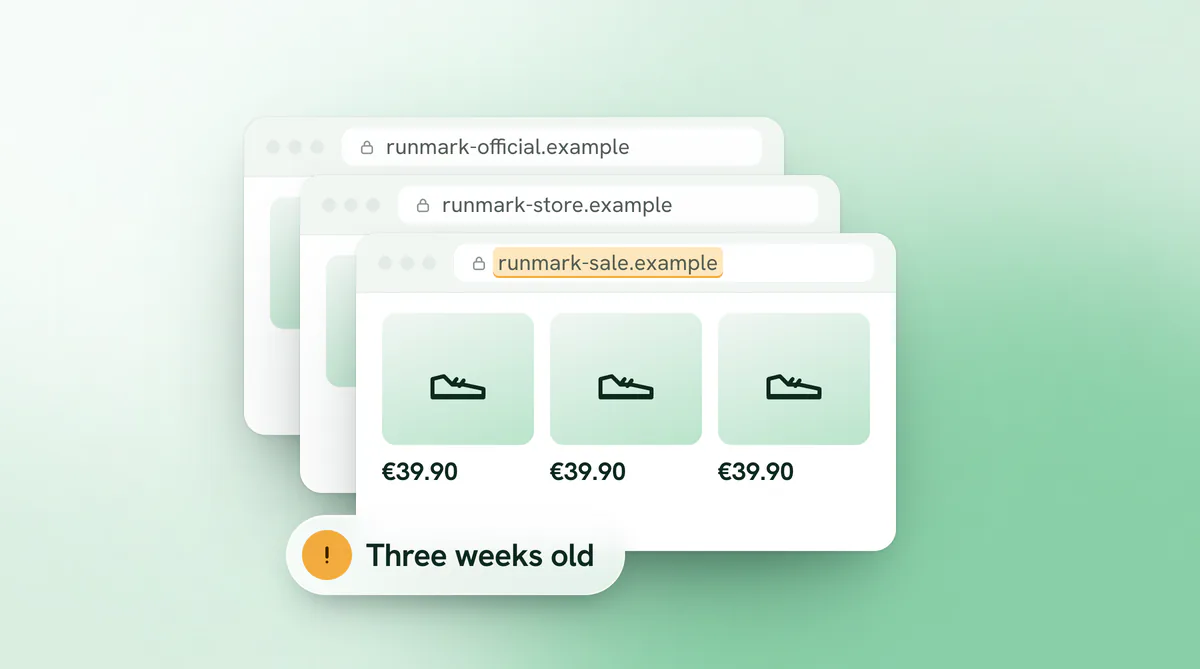
A domain only a few weeks old on a shop selling branded goods deserves suspicion. The shop check shows the age.
- Choose a payment method with a way back.
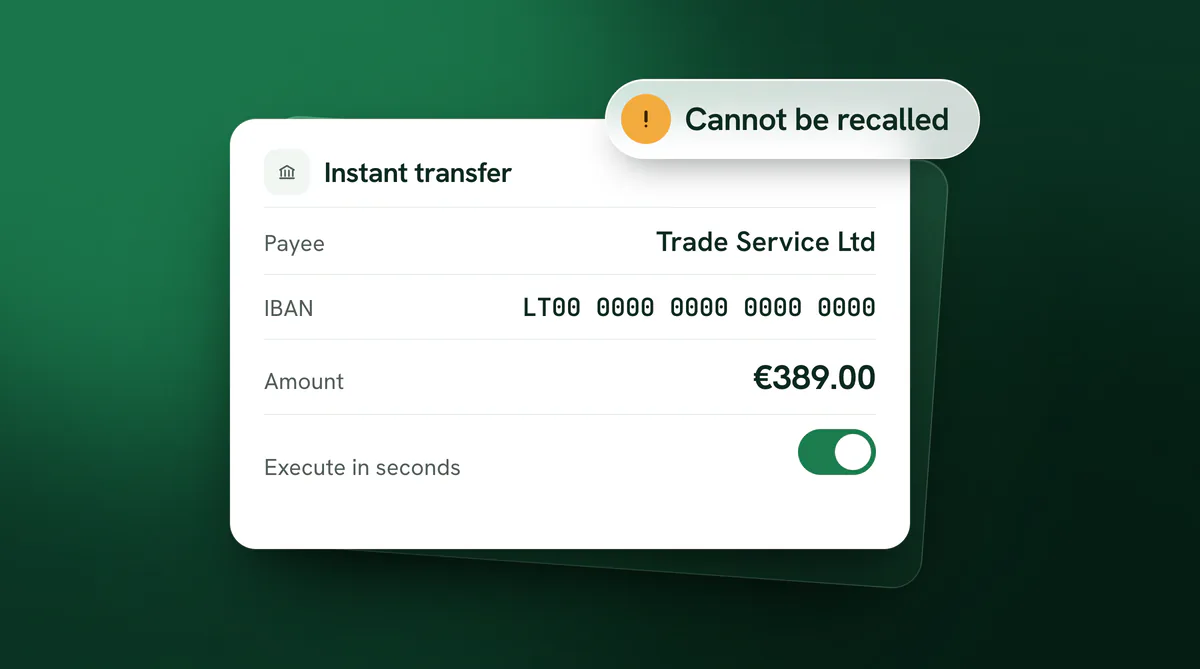
If the shop offers invoice, Klarna or direct debit, pay that way. If only the bank transfer is left when you order, take a closer look. The Verbraucherzentrale calls shops that offer only prepayment or bank transfer a warning sign.
- Ending, shop software and Cloudflare decide nothing on their own.
They count only together with the other traces. Before shopping on Black Friday, 27 Nov 2026, compare the shop address with the warning list and read in checking shop reviews how to judge ratings.