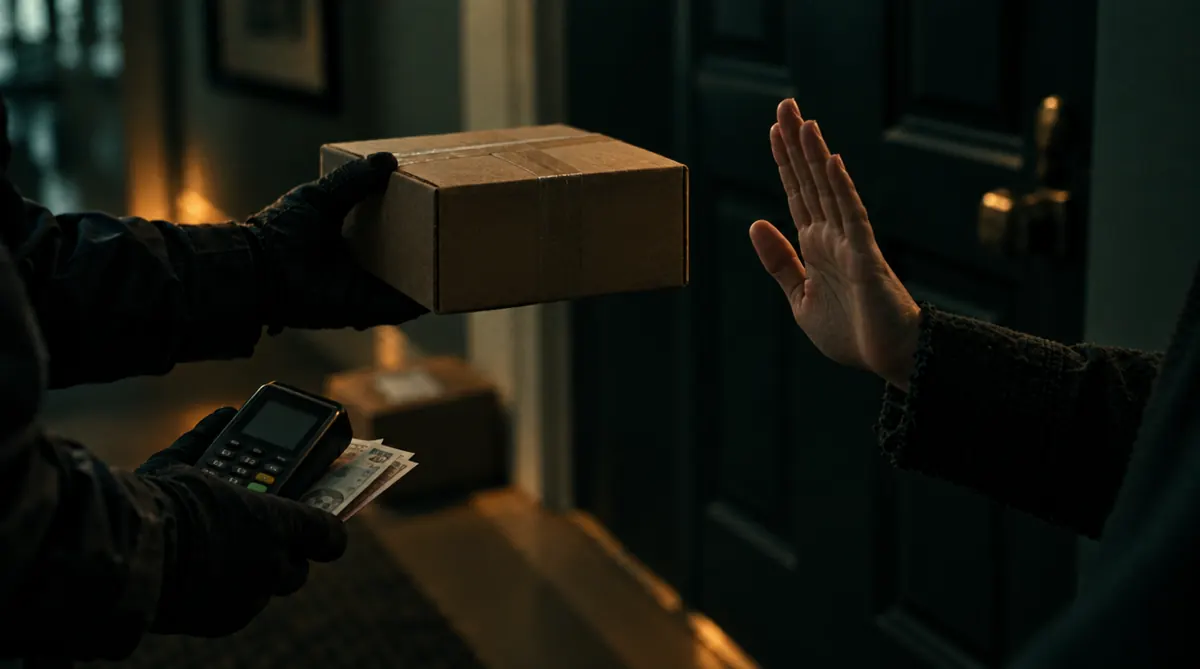
The courier stands at your door with a parcel and wants cash for it. If you ordered nothing or do not trust the shop, do not accept the parcel and do not pay. Once the money is with the courier, the consumer advice centre and Watchlist Internet say you will hardly get it back.
The courier collects before you see the parcel
With cash on delivery, the courier collects the amount for the sender. DHL writes that the driver hands over the shipment only after accepting the payment. A cash-on-delivery fee is added; for DHL the Verbraucherzentrale names 8.99 euros on top of postage. You have to be present in person; dropping it in your letterbox is not provided for.
Fake shops and senders of unordered parcels exploit this. The Verbraucherzentrale writes that dubious providers send parcels to random people. In the worst case you pay for something you did not order, and the company is mostly untraceable.Watchlist Internet describes how offenders pick addresses where several people live or work. It works best when family members or colleagues open the door and pay out of courtesy. The named senders are relatives, familiar-looking companies or invented firms.
A case from Thuringia, reported by inFranken, shows how it can end. A 29-year-old wanted to buy a phone for 510 euros through an online portal, paid cash on delivery and, according to the police, found a packet of coffee in the parcel instead of the phone.
At the door: what to do
- Check whether there is an order.
The Verbraucherzentrale advises checking before payment that a matching order exists. Ask housemates and family too. Watchlist Internet recommends accepting cash on delivery only if you expect a parcel and know the sender.
- If you expect nothing, refuse delivery.
Tell the courier that you do not accept the parcel. The shipment then goes back to the sender. DHL offers digital refusal of delivery as long as the item has not yet been loaded into the delivery vehicle. DHL does not mention cash-on-delivery shipments there, so it is not documented whether this route is open for them.
- Do not pay for others.
If the person the parcel is meant for cannot be reached, Watchlist Internet says not to accept it. There is a new delivery attempt, or the parcel waits at a parcel shop.
- Write down the sender and tracking number.
You need both for a later police report or if an order does turn up.
- Do not reply to the sender in a friendly way.
According to the Verbraucherzentrale, a reaction to an unordered delivery, such as a thank-you email, can count as accepting an offer.
If you know the sender’s name or web address, enter it in the shop check. It tells you what we find about the domain and operator and does not replace a decision at the door. The warning list collects warnings from other users.
Unordered goods: what Section 241a BGB says
If a business delivers goods to a consumer that the consumer did not order, Section 241a(1) of the German Civil Code gives the business no claim against the consumer. The Verbraucherzentrale sums it up: the mere arrival of goods does not create a purchase contract. In a dispute the shop has to prove that you ordered.
You generally do not have to send unordered goods back. If you want to be rid of them, contact the sender and agree on a return at his cost; do not pay in advance. The consumer advice centres recommend keeping the goods for about six months in case of a delivery error. It is different if the goods were obviously misaddressed or delivered twice. Then the trader can ask for them back.
This is German law. The Verbraucherzentrale points out that getting money back becomes harder once you have paid.
You ordered from the shop and do not want to pay
It is different if you triggered the purchase yourself, for example at a shop that steered you to cash on delivery in the last step. Then a contract exists and Section 241a BGB does not help. The right of withdrawal for online purchases applies. The Verbraucherzentrale describes it like this: you withdraw within 14 days, without giving a reason and without a set form. The period starts when you receive the goods, but only once you have received the withdrawal information.
The form matters. According to the Verbraucherzentrale it is not enough to send the goods back without comment; you declare the withdrawal to the seller. Without a withdrawal button in the shop it advises an additional declaration by email or registered letter. If you refuse delivery at the door, also write to the shop that you withdraw. The trader has to refund your money within 14 days of receiving the declaration but may wait until he has the goods back.
It looks like fraud if the shop has no imprint, does not answer or tells you to pay anyway. Then a police report is left. How to secure records is under Securing evidence.
Cash on delivery and advance payment compared
Neither way of paying leaves you much leverage after payment. With advance payment you transfer money to an account, which the article Advance payment in online shops describes. With cash on delivery you pay cash and hold the parcel but do not know the contents. No payment service or bank is in between through which you could start a chargeback.
Whether you may open the parcel before paying is not regulated. The Verbraucherzentrale only writes that you can at least check it for outward damage. According to Stiftung Warentest, quoted by inFranken, the postal service does not have to let the recipient look inside before paying. You can still ask.
Already paid
- Secure what you have.
Photograph the parcel, label, contents and the receipt. Keep the packaging.
- Ask the sender in writing for a refund.
This is only worthwhile if contact details are given. Watchlist Internet writes that offenders mostly do not respond or ask for more data or identity documents. Do not send a copy of your ID.
- Do not expect a refund through the postal service.
Watchlist Internet writes that a refund through the post is no longer possible in a problem case. The sender would be responsible.
- File a police report.
Your state’s online police station is listed under Reporting offices. The article Reporting a fake shop explains how to describe the case there.
In Austria
Watchlist Internet is an Austrian body, and its warning applies there as here: accept cash on delivery only if you expect the parcel and know the sender. According to Watchlist Internet, an amount that has been paid cannot be reclaimed through the post. Reporting offices in Austria are listed under Reporting offices Austria. The legal notes on Section 241a BGB above concern German law.