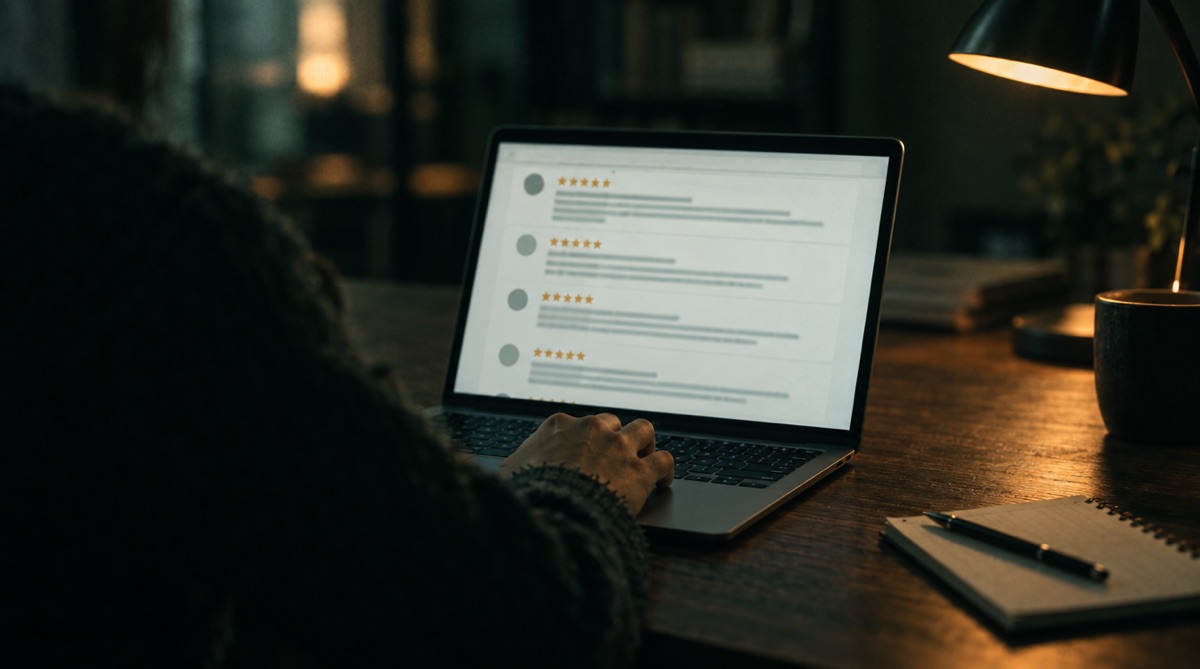
Before ordering from an unknown shop, people often search for the shop name together with a word such as “experiences”, “legit” or “fake”. Our own figures show this. Reviews help with that decision, but only if you know where they come from and how they come about.
What our search data shows
Google Search Console shows us which search queries bring people to fakeshop.ai. From 3 to 16 August 2026, 248 of the 500 queries with the most impressions contained one of the German words “erfahrung” (experience), “seriös” (legit), “fake”, “betrug” (fraud) or “bewertung” (review). 231 of these 248 queries also contained a shop name. These queries accounted for about two thirds of all impressions in this selection.
Asking about experiences is therefore the most common way people check a shop. This article shows how to interpret the answers.
Where to find experiences
Reviews on the shop page itself are under the operator’s control. They may be selected or faked. The consumer advice centre writes that many fake shops fake reviews or leave them out altogether. The German police crime prevention service (ProPK) therefore advises using independent platforms such as Trustpilot or Watchlist Internet. The Lower Bavaria police recommend searching the internet specifically for negative experiences of other customers and in forums.
- Search engine. Enter the shop name together with “reviews”, “fraud” or “fake”. Search for the domain name in addition to the brand name shown on the page.
- Review platforms. Make sure the reviews refer to the same domain as the shop in front of you.
- Warning lists. Watchlist Internet maintains a continuously updated list of fraudulent online shops. Our own warning list shows domains we classify as dangerous, together with the source of the classification.
- Checking tools. The consumer advice centre’s fake shop finder and our shop check analyse the page itself. The shop check shows, for every feature checked, what was found and why it matters.
Same name, different domain
A common mistake is to apply the reviews of a genuine company to a fake shop. Fake shops take over the names and company data of existing businesses. The Lower Bavaria police describe a case in which the company profile of an existing firm was used for a fake page. Anyone searching for the company name then finds good reviews that belong to a different offer.
A fictitious example: a genuine company “Holzhandel Muster GmbH” has sold for years at holzhandel-muster.example and has many reviews there. A fake shop at holzhandel-muster-shop.example copies its logo and legal notice. Searching for “Holzhandel Muster reviews” returns the good reviews of the genuine company. Only a search for the exact domain shows that there are no experiences with holzhandel-muster-shop.example.
How fraudsters use genuine trade register data is explained in the article Genuine HRB number, fake shop.
How to recognise bought or fake reviews
In its 2020 sector inquiry into user reviews, the German Federal Cartel Office found that fake reviews are a widespread phenomenon. Most portals at the time only used word filters or relied on reports after the fact. The consumer advice centre lists these warning signs:
- Many positive reviews in a short time. A shop that had no reviews for weeks suddenly gets dozens.
- Recurring wording. Identical text modules or very similar sentence structure across several reviews.
- General texts without experience. Smooth language without personal details, exaggerated praise that reads like advertising, no criticism.
- Only five stars. The reviewer gives nothing but top marks.
- Verified purchases too. According to the consumer advice centre, reviews marked as a “verified purchase” can also be bought or manipulated.
The consumer advice centre also describes how providers influence reviews: bought reviews from people who never had the product, sponsored reviews in return for money, free products or vouchers, and pressure on customers to delete negative reviews. In its assessment, AI has made it even easier to publish many fake reviews in a short time.
What the law requires of shops
Since the reform of the German Unfair Competition Act (UWG), fixed rules apply. Under Section 5b(3) UWG, anyone who makes customer reviews available must state whether and how they ensure that the reviews come from people who bought or used the goods. The annex to the UWG prohibits, under no. 23c, submitting or commissioning fake reviews. Under no. 23b it is unlawful to claim that reviews come from genuine buyers without reasonable measures to check this.
For you this means: a reputable shop with reviews explains somewhere how it checks them. If this notice is missing, that is no proof of fraud. It is a reason to give less weight to the reviews on the shop page. The Federal Cartel Office considers incentives such as vouchers permissible as long as the reviews are clearly labelled as such.
Review platforms and their limits
Large platforms also deal with fake reviews. In its Trust Report 2025, Trustpilot states that it removed around 4.5 million fake reviews in 2024, about 7 percent of all reviews submitted. These are the company’s own figures. They show that part of the reviews submitted to independent platforms are fake too.
So read the distribution and the content. A few concrete reviews with delivery date, goods and process say more than many short lines of praise. Look especially at the bad reviews. If they repeatedly say “not delivered”, “prepayment only” or “no reply”, that is a clear signal.
When there are no experiences
Often a search for a shop returns nothing at all. There are two possible reasons. The shop is small and little known, or it is new. Watchlist Internet describes how operators open new shops and register new addresses after a takedown. A new fake shop therefore has no reports yet and is on no list.
In this case an empty search result is not a verdict, neither for nor against the shop. Then the features of the page itself help: domain age, legal notice, payment methods, trust seals. This is where the shop check comes in. It provides an assessment even for shops nobody has written about yet, and gives the reasons. How to verify a trust seal with its issuer is explained in the article Forged trust seals.
Order of checks
- Note the domain.
Write down the exact address from the address bar, including the ending.
- Check warning lists.
Look in our warning list and at Watchlist Internet.
- Search for experiences with the domain.
Search for the domain together with “reviews” and “fraud”. Check whether any reviews found belong to this domain.
- Read the reviews.
Watch for the warning signs above and read the bad reviews first.
- Check the page.
Enter the address in the shop check or go through the features under Spotting a fake shop yourself.
- Pay safely.
If doubt remains, choose a payment method with chargeback or buy on invoice. Deadlines per payment method are under Getting money back.
More features of a trustworthy shop are in the article Recognising trustworthy online shops.


